Eleven Years of Twelves

It began with a mildly selfish thought sometime just over a decade ago - wouldn't it be nice to look at some of these images I had made, printed and hung on the wall? The initial hurdle was choosing which image we'd choose. Why not do a calendar, then? In that case, there would be no need to whittle the selection down to one. A dozen of them, each month features a new photo - and so the seed was sown for what has become a sort of legacy.
2016 marked the first year of this now fixture on our walls - an elegant looking 11"x17" wall hanger, each page with a 9"x9" image (that has since expanded a bit), a short blurb, and of course, the respective month's innards. Over the years we experimented with a couple different formats and presentations; one year there was a neatly condensed desk version, featuring the same images as the larger calendar, another year we made one featuring the herpetofauna of Trinidad & Tobago. The year following our first safari, out came a safari calendar as well. Accompanying each of these was the staple 11"x17" - always featuring strictly birds. Most years, the birds of T&T.
There was an educational component of the calendars too; that blurb which accompanies each image. When considering whether to feature birds from my travels a couple years ago, it was brought to my knowledge that I had a responsibility of educating people by virtue of these few lines - prior to which I had no confirmation that people actually read the words. Thus, despite having been sent to various places within the last couple of years, we continue to feature the gorgeous birds of Trinidad & Tobago on this calendar.
The 2026 edition brings forth a more muted palate, along with a realisation that I haven't spent a lot of time in Tobago this year. While I present the images in this blog post in their original, uncropped form, within the calendar they appear as squares.

The square is a primitive, yet timeless representation of the circle. To compose within a square is to understand balance - not all images can work in this ratio. All twelve squares then work together as tiles to form the collection, one which is rarely perceived by the user, surely. To us who have conceptualised and curated it, however, the collection is far more important than the individual images. There have been more than a few favourite images which were excluded from various calendars over the years merely because they did not fit the vibe of the collection.
If you'd like a glimpse of all eleven 11"x17" calendars, you can see them on this video.
For now, I'd like to share the collection in its entirety here, along with some behind-the-scenes information. Please enjoy, and don't forget to grab your copy!
January

This Burrowing Owl was reported by a member of the local birding community from a very sensitive worksite. As part of my responsibilities as a member of the T&T Birds Status & Distribution Committee, I was required to visit the site and document the individual. I arrived early the next morning, quickly cleared the security at the entrance, and sure enough, next to a huge mound of dirt was a relatively tiny mound of dirt. An owl-shaped mound of dirt with two bright yellow eyes. It wasn't my first Burrowing Owl, but I had snobbed the previous sighting as it was on a utility wire - so these were my first photographs of the species. It is a rare record for Trinidad, they spontaneously appear in strange places. Although this one seemed to be rummaging around in the dirt over a rudimentary burrow, there was no second bird in sight.
February

When I saw another local birder share an image of a Yellow-breasted Crake on Instagram, I couldn't believe my eyes. When he offered to take me to the spot, I again pinched myself in disbelief. I knew that I had many more pinches coming, should I actually get to see this ghost. See, Yellow-breasted Crake is one of those birds that ends up on a checklist because it was heard vocalising. No attempt is made to see one that calls for fear of eternal frustration. They are known to be resident in many wetlands throughout Trinidad, where they are thought to possess the ability to teleport. Nevertheless, I went, and without much fanfare, the bird showed up after a short while, unconcerned - just as we prefer.
March

I came across a pair of duetting White-bellied Antbirds after being released from a botched arrangement to take a couple folks birding. After arriving on location well before sunrise, I learned that the guests were likely still asleep - expecting me the following day. Freshly liberated from this responsibility, I found myself roaming the forest, like any self-respecting birder would. While common, this species has proven to be a bit elusive for me over the years. As such, I was thrilled to encounter a pair of them in this tangle of decay.
April

Grey-cowled Wood-Rails are notoriously shy, never mind their raucous vocalisations. It would seem that if an animal is making that much of a racket, it must surely not mind being seen. Typically, however, from the time they notice the presence of a human observer they'd skedaddle - heads extended forward, their bright red legs whirring overtime. On this occasion, I was in my vehicle when I heard the distinctive assortment of notes - and I stayed put, using the vehicle as a hide. My method paid off, the birds soon emerged, entirely absorbed in their own affairs.
May
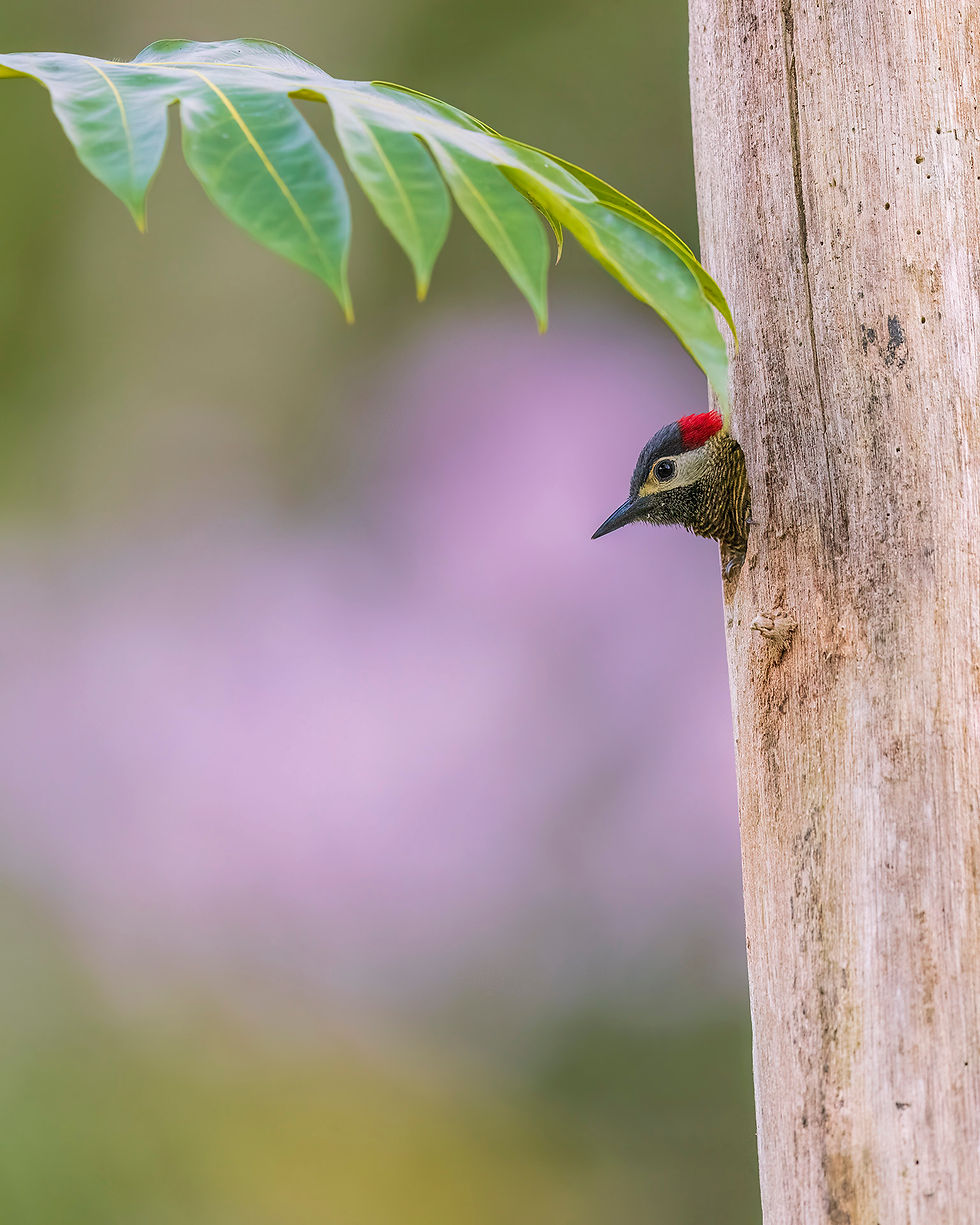
May is a colourful month in T&T, well it was anyway before climate change began to confuse trees. A pair of Golden-olive Woodpeckers occupied a nest hole for some weeks where we live, and while I never observed young birds there, I enjoyed seeing the adults poking their heads out for long periods. Distant flowers provided the splash of colour for this frame.
June

Again, the influence of wildflowers is present here, this time in deft droplets of red. The gentle light of the mostly shadowed background contrasted nicely with the backlit Cocoi Heron - one of the largest birds to inhabit T&T. Very often when photographing birds in flight I'd end up missing focus as a wing crosses the bird's face - this time I lucked out and it all turned out pleasantly in the end.
July

I left home early one morning to visit some friends who were staying not too far away as the crow flies. Roads, however, took a different path - my options involved the open highway (head north, then west, then south), or take the interesting and more direct route in a general west-southwest direction. There was little debating involved. Some of the roads were closed, and I relied on my innate sense of direction through farm roads across the gently undulating Central Range to ultimately arrive at my destination. Not before stumbling upon a recently burnt field (I still can't believe that people light fires in the dry season) that was replete with Dickcissels and a smattering of Shiny Cowbirds. The incessant chattering of these birds is what gave their presence away - had I not heard the birds first, there was little other sign of their presence. Despite their bold markings, they are fairly difficult to see. I rolled the vehicle around the field such that I could shoot directly into the rising sun, and all was complete. Yes, I love backlighting!
August

There is honestly little to be said of this image - in a "hummingbird garden" there are often far too many moving objects to pay attention to any one thing in particular. This young Ruby-topaz Hummingbird was catching some sunlight on this branch, and just as I pointed my camera to it another bird buzzed past and riled the youngster. I wish I could say there was meticulous planning and advanced technicalities involved, but sometimes you point, and shoot.
September

This image is such a special one to me that I wrote an entire blog post about it.
October

There is something special about sitting silently at the water's edge observing the birds that have mastered multiple realms. Grebes take it to another level, despite their superficial resemblance to ducks, they do not merely paddle around on the surface - they dive. Of the two species of grebe found in T&T, this one, the Pied-billed Grebe, is the larger. At one point in time while photographing this individual, it drifted reasonably close to the very diminutive Least Grebe - the size difference between both species became spectacularly stark at that moment. Pied-billed Grebes are fairly rare in T&T, and I had made the journey to photograph this individual at the crack of dawn. Once getting myself in position, I began to wonder if the bird had wandered off, as there was no sign of it. As the morning proceeded, however, and the sun was just about to crest the treeline, it popped out of a mat of floating vegetation where it had spent the night. To my amazement, it began its morning routine of preening and - even more surprisingly - having a bath. Who knew that a bird that spends most of its time submerged would still need a bath!
November

Returning home after several weeks on safari always involves a process of reacquainting with the usual characters around the property. Very often the birds that we bid goodbye to are not the same ones who welcome us back. New nesting pairs, birds that have returned to the mainland, and birds returning from the far north - the avifauna is always changing and there's always a surprise. When this takes the form of the smallest kingfisher in the Western Hemisphere, nobody complains! Always love the opportunity to photograph American Pygmy Kingfishers, on a beautiful mossy branch made it so much better!
December

Photographing birds at a fruit feeder is much more in the interest of the viewer than it is for the photographer. It is the essence of lazy birding - even lazier if your camera is mounted on a tripod and already points in the direction of where the birds are showing up. On a good day at the feeders, it is a revolving door of all shapes and colours. Bananaquits, tanagers, and honeycreepers emblematic of the Neotropics boast some vivid colours, this Bay-headed Tanager is no different.
The most recent hurdle with these calendars involves geopolitics, trade restrictions, tariffs - I'm not even sure what is the real reason. Last year I realised that the government of T&T began blocking incoming payments on PayPal - which meant that everyone who ordered calendars outside of T&T had no means of paying for them. While I have fixed that issue this year via the usage of another platform, posting them to the USA now involves an exorbitant cost - as they are now classed as "exports", and no longer can we simply slap some stamps on the envelope and send them on.
Time will tell if we persevere further with this calendar, I do enjoy putting the collection together - and still enjoy that original selfish reason of seeing my own work on my wall. Here's to a wonderfully uncertain future, wishing you all the best for 2026. With gratitude and grace.


Geopolitics can’t stop your talent Faraaz! ✊🏽 Long live the birds! 🦅