Attractive or Appalling: The Case of the Misunderstood and Maligned Hyena

Of all the charismatic megafauna expected on safari, hyenas tend to get the worse end of the stick each time. They rarely end up on people's "must see" lists, and oftentimes folks are genuinely surprised to see these oddly proportioned characters whilst scouring undulating grasslands for evidence of felines. Hyenas have a niche audience which mostly includes people who know about them – they are in fact truly remarkable creatures fully worthy of adulation. Sadly, the majority of the audience is informed by popular culture, and hyenas have long been vilified on the big screen. Portrayed as scoundrels, wicked beasts laughing maniacally long into the night, nothing could be further from the truth.
Not being an expert on hyenas by any means, I unearthed this article when preparing this post. I was amazed at how little we know of hyenas, especially some of the more secretive species such as the Brown Hyena (which I've never personally seen). The much more frequently encountered Spotted Hyena has been the subject of numerous studies as well as wildlife documentaries. These highly social animals (neither cat nor dog, but more closely related to genets and mongooses) live in groups dictated by matrilineal authority. The matriarchy is so strong within hyena society that females are larger than males – enjoying rights that are passed onto daughters and granddaughters – the matriarch rules with an iron, er, pseudopenis.
That's right, female hyenas have a tremendously enlarged – and imposing – Swiss-army clitoris that is used for almost every conceivable social interaction. From greetings to conception itself to an incredibly risky birth, this only sometimes flaccid organ confused early hominid observers.
Hyenas are incredibly intelligent and resourceful, and this may have played a significant role in their image being cast as wily scavengers. After all, if it is easier to pilfer from someone else's efforts, then why not?
Apart from these tidbits, I came to realise that hyenas are far from being a guaranteed sighting on a safari. Nothing is certain when all is subject to the whim and fancy of the great beyond – on our first safari in 2019 we didn't see or even hear a single hyena. When we returned to the continent five years later, we managed our first sighting of a Spotted Hyena. They seem ungainly, one can't help but wonder how that gait supports long-distance travel. Nevertheless, they are consummate masters of their environment and their craft.
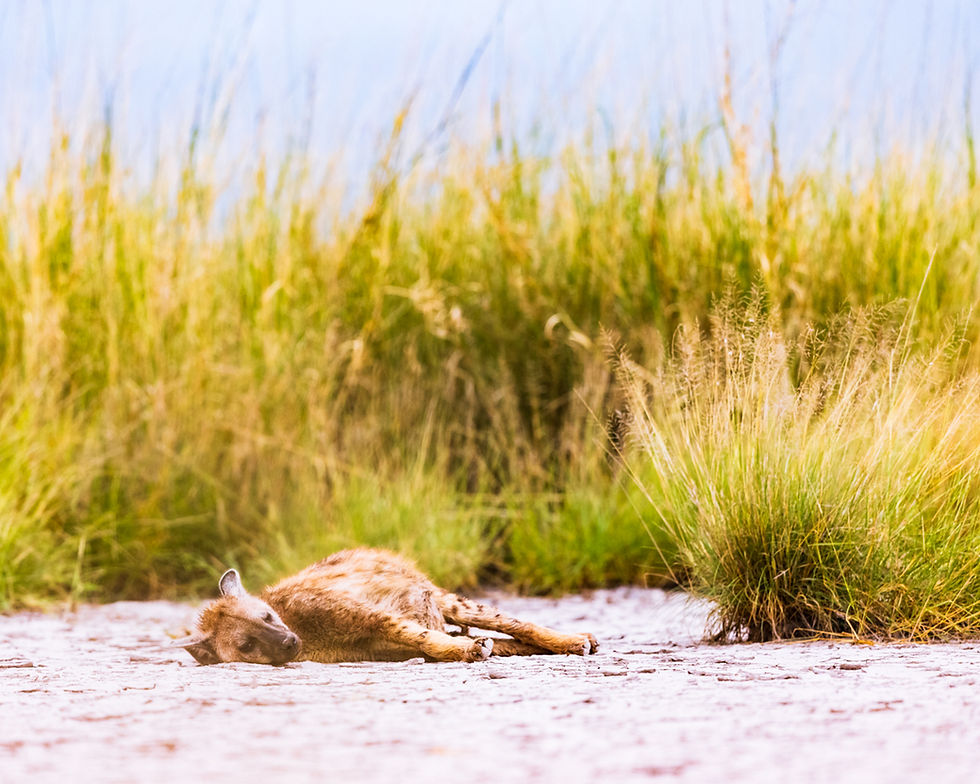
As mentioned earlier in this article, hyenas aren't cats, and surely cats worldwide look upon animals that are not fastidious in grooming with at least slight disdain. Our first Spotted Hyena was disheveled at best, looking a bit as though it had fallen asleep in a river bed only to wake with the return of the water. Only a few days before this sighting, we were jolted from some after-dinner relaxation in our room in Tsavo West by the signature whoop of a hyena somewhere in the darkness. I photographed that individual some minutes later as it drifted closer to the watering hole behind the lodge, but those images ultimately ended in discard pile after photographing hyenas in daylight.

Truth be told, it must be tough to find a suitable space for a snooze in a place that's either dusty or inundated. Some days later, we found another hyena (potentially the same individual) asleep in very much the same area we had seen the first one.
In Kenya's Masai Mara, famous for its sprawling landscapes and large carnivores, we caught up with a few more Spotted Hyenas eventually. Breaking the calmness of the onset of dusk one evening, there was suddenly an urgency in the hyena camp – with several individuals breaking into a run. I don't know where they were off to, or what was going on. All I knew was that there was something happening, and they were on the case.
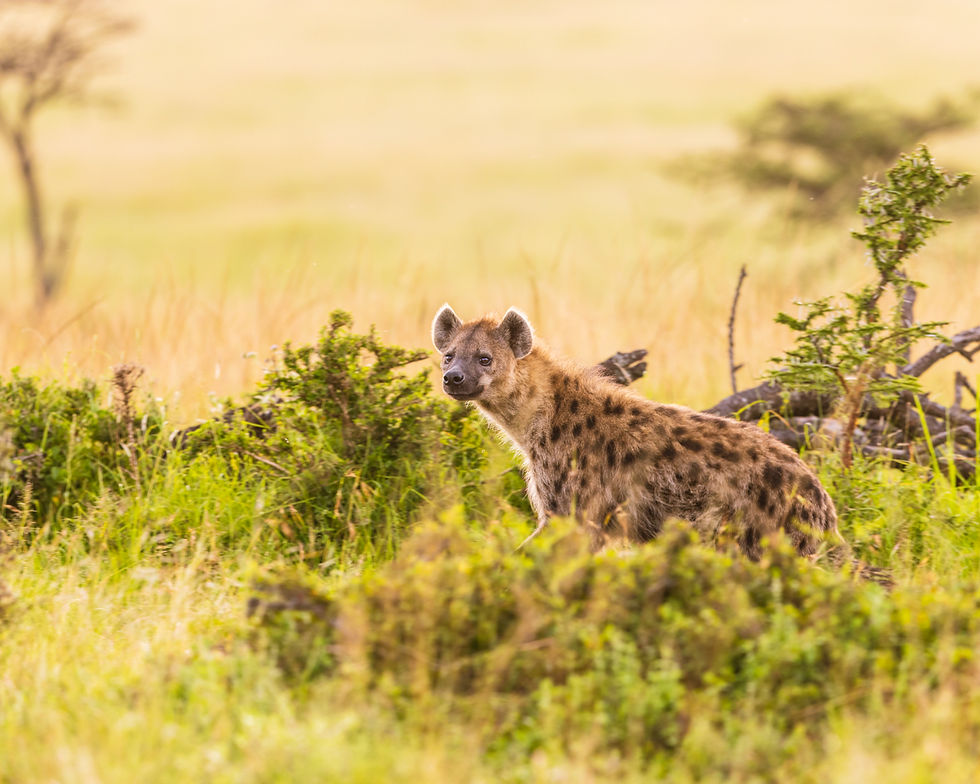
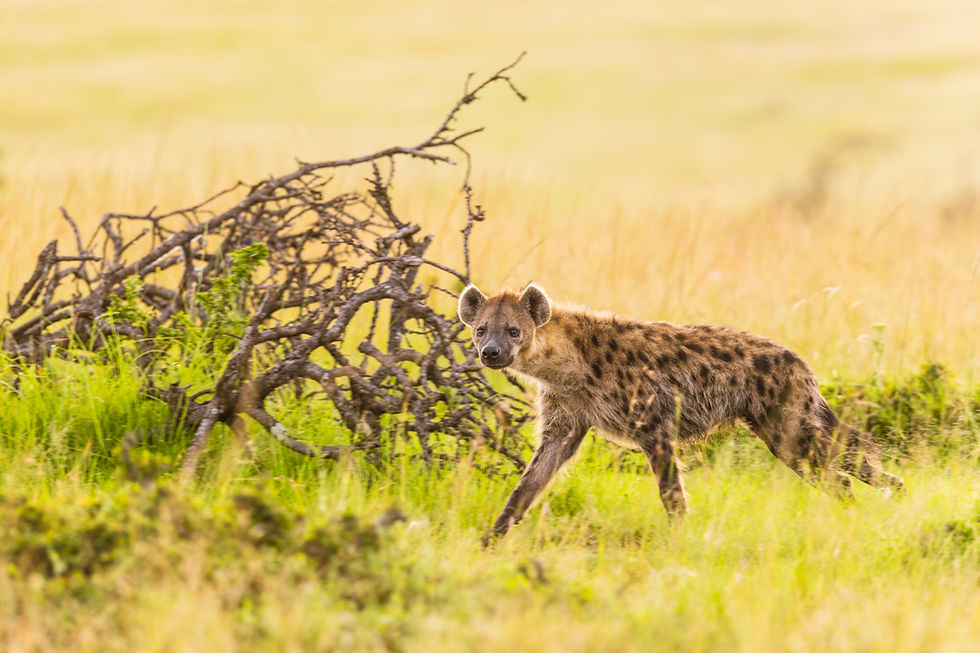
It is difficult to convey the movement of a hyena, but I felt as though I did the best I could in the image above: curious, attentive, yet moving half of its body at a time. Front feet on the ground with hindquarters in full gallop. While I've never seen hyenas at a kill, whether scavenging or otherwise, I've seen reddish hyenas. A closer look at the image below should reveal the source of the reddish coloration.

One morning in the Mara, the not-so-distant roar of a lion roused us from an otherwise restful slumber. After our breakfast, we came upon a recent buffalo kill, attended by around five lions. Nearby, a single Spotted Hyena lay comfortably, without doubt keeping an eye on the massive cats.

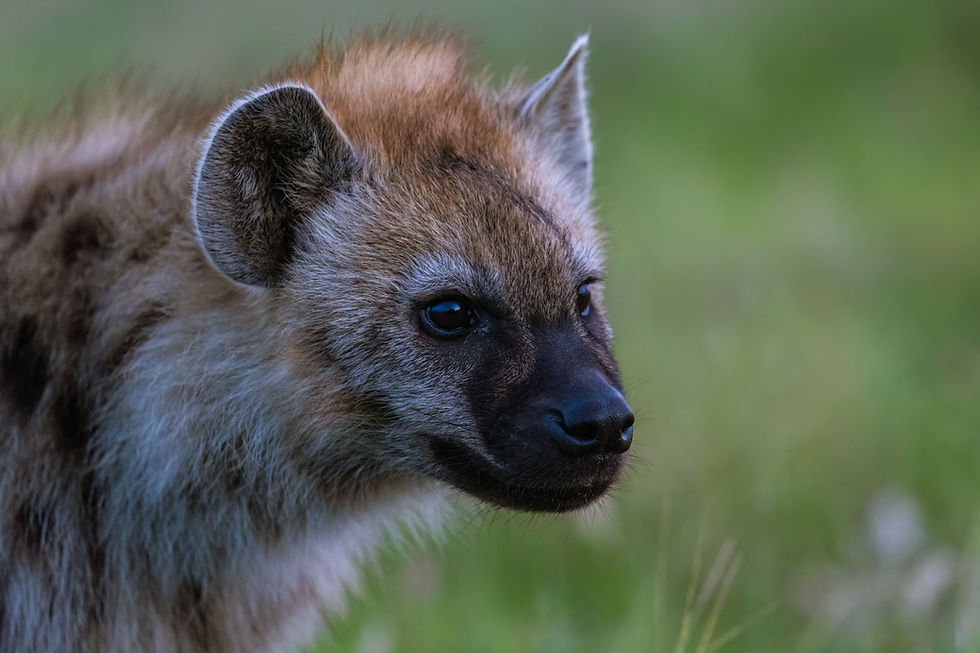
In observing the natural world, very often I've witnessed a phenomenon whereby something that has remained hidden reveals itself – and is subsequently encountered frequently. After missing out on any hyenas on our first safari, we've since seen them in several places, from Amboseli through the Masai Mara, and even in Nairobi National Park. Our most prized sighting was of a pair of hyena cubs late one evening in the Mara. The sun had already set and we were on our way back to our lodge but stopped to admire these little critters. They weren't tiny, and even though they didn't have the famous bone-crushing bite strength until they turn five – I still didn't want to chance it despite how fluffy and cute they were.
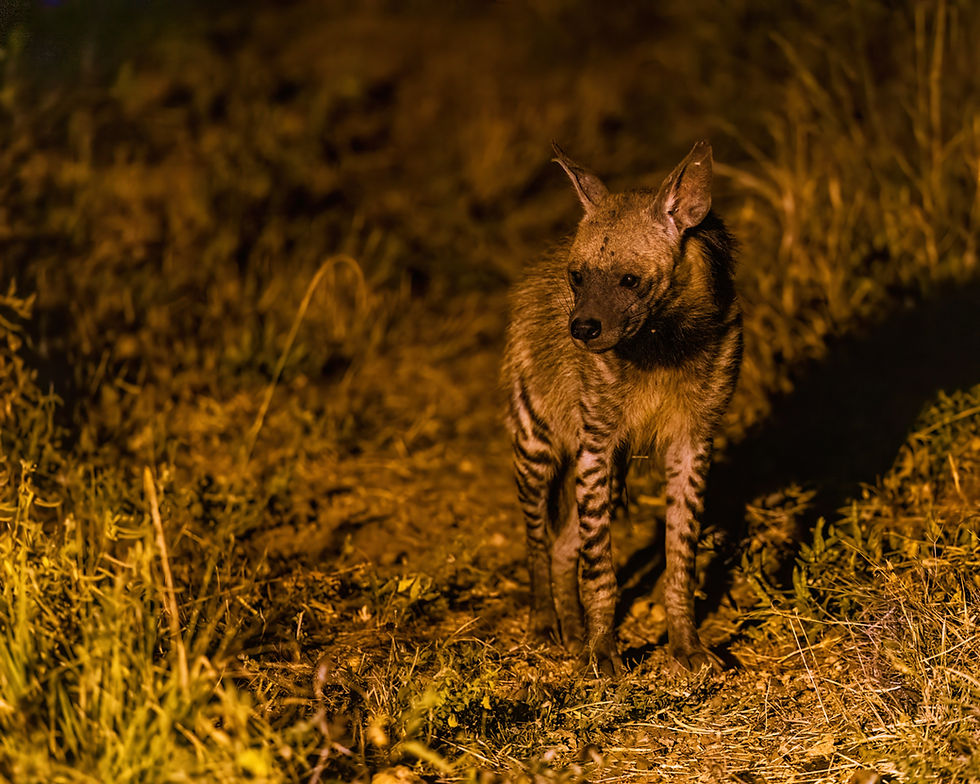
A bonus sighting late one evening in Samburu came in the form of a Striped Hyena that materialised from the bush after dark. As excited as I was, I didn't take into consideration that it came and sat comfortably under a light at the lodge we were at. I was merely thrilled to finally lay eyes on a Striped Hyena! After seeing hotel staff toss some meat for it, this sighting took on a slightly different flavour. Nevertheless, what an animal.
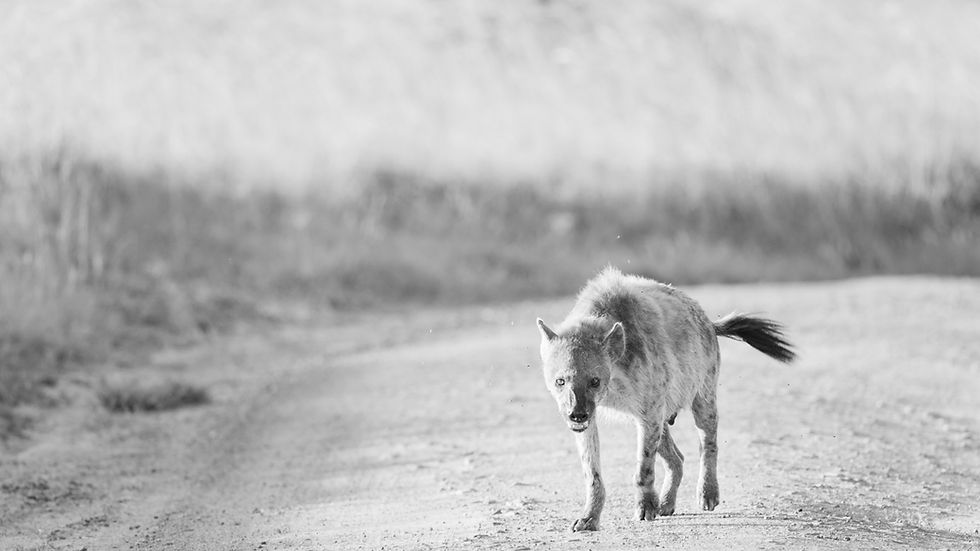
I hope that this post has encouraged you to view hyenas fairly, without the biases thrust upon us by Disney (as this is by far the most commonly cited cast of characters on safari). I leave you with this parting image that also appeared in my B&W series: the light that hits this approaching Spotted Hyena does so in precisely the angle to illuminate yet another incredible feature of this amazing animal: its vertical pupils.


Comments