A Few Steps Away

Those who have miraculously managed to keep abreast of my work in the recent past may have noticed my absence across much of the tiny corner of the internet I occupy. If it wasn't blatant enough before, my overall disdain for technology, ultra-connectivity, and trending content positively bubbled over at the turn of the year. Last December we spent a week in Guyana (more on that to come soon, I promise) during which I spent virtually zero time on social media. My visibility plummeted, traffic on this website slowed significantly as well. But I felt so invigorated! Upon my return to Trinidad, I buffeted my time on socials with frequent, scheduled time-outs. My ability to focus drastically improved, and relief flooded in.
It followed naturally, therefore, that for my next planned trip I opted for a tech-free fortnight. Announcing this on social media (see this post) of course drew above-average attention. Likes and comments flooded in like never before – not because the image itself was particularly better than the others I had shared previously – but due in no small part to the bots scraping my profile that inform the wider algorithm that this user should be hit with some more dopamine in an effort to reel me back in. Fortunately, my notifications are permanently turned off, and I was able to comfortably turn my back on these platforms.
Going birding often involves a certain degree of participation in the tech world. For example, many birding trips are documented reliably using eBird. It makes it easy to record sightings in real time, when the trip has come to a close a trip report can be generated and shared with a few clicks. Despite its significant value to citizen science, and notwithstanding my contributions to the database in the past (interestingly I ended up being the top eBirder in T&T in 2025), eBird also got the axe for this sabbatical.
I was therefore, embarking on a much more traditional birding tour. One in which I was not preoccupied with creating content, entering species while in the field, or checking any notifications once back at the hotel. Instead, lists were printed, and relied on memory for the daily update at dinner. For memory to work, one must be present – a key to a plethora of other advantages.
This tour, while listed on my tours page, was not publicly available. It was a custom clean-up tour of Trinidad, St. Lucia, St. Vincent, and Barbuda. Regular readers of my blog would remember a pair of back-to-back Lesser Antilles tours I led last year (see this post), both which traversed roughly the same path across 9 islands. Usually the trips are 10-island trips, but each time we attempted to visit Barbuda we were thwarted by dangerously high winds. A couple who was on the first of these enlisted me to accompany them on this new quest, with specifics in mind.
John & Cindy had been to T&T before, all the way back in 2004. On that trip the itinerary did not provide an opportunity to visit Grande Riviere for the Critically Endangered Trinidad Piping-Guan – a single-island endemic unique to Trinidad's remote northeastern forest. They arranged a post-tour excursion to try to see this bird then, which never came to pass thanks to domestic flight cancellations. By the time they returned to Trinidad from Tobago, seeing the guan became impossible. Due to the fact that I was from T&T and myself a birder of some repute, we included Trinidad on this tour with the heaviest goal being this endemic.
There were other targets on Trinidad, of course, and our tour began on the grounds of Hacienda Jacana. While getting ourselves sorted for a pre-tour grocery mission, I heard the unmistakeable jangle of a displaying male Sooty Grassquit. Target 1, acquired. Well, I speak with such confidence there I wish the other birds played it easy like that. That afternoon, we managed a lovely view of a pair of Red-bellied Macaws that flew in above us. Smooth sailing to get the ball rolling, including crippling views of a feeding Little Hermit. We tried in vain to catch a view of any Short-tailed Nighthawks, but none showed themselves before darkness set in.


The first bird we found the following morning wasn't on the list of targets, but a very uncommon sight: a (very distant) Crane Hawk that was cruising south in the pre-dawn glow. We were on Trinidad's western end, and delighted ourselves in a visible Striped Cuckoo, as well as a Green-throated Mango. A Merlin alighted on a small bush while we were prowling for any view of a Yellow-breasted Crake. Sadly, we ended up leaving without seeing the crake – a foregone conclusion some would say, but we had hope! From there we headed further westward still, this time for a tiny, range-restricted species: Blue-tailed Emerald. By this time it was already hot (we were retreating from the sun while looking for the crake) and we had a choice to make: either hike uphill in dry forest for about an hour to get to a point where the birds are almost certain, or sit in the bus in the shade with our eyes on a patch of flowers I knew the birds couldn't resist. There was some deliberation, but ultimately we landed on the latter option. Within a few minutes we had already clocked sightings of Black-throated Mango, Ruby-topaz Hummingbird, Copper-rumped Hummingbird, and Blue-chinned Sapphire feeding at this patch. Our target species made us wait for some time longer, but eventually we were rewarded with exceptional views of first a male, then the very distinct female.


With that under our belt, we began the eastward journey home. Not before going on a local twitch, however! In the middle of Port of Spain there had been sightings of a pair of Whistling Herons, and as we were in the area, we couldn't resist. No pictures, sadly, but I can assure you it is tough to not enjoy looking at one of the most beautiful herons on the planet.
The next day found us traversing the very birdy Arima-Blanchisseuse Road, in search of some of Trinidad's montane forest specialists. Antbirds were high on that list, and before long we stopped at a point where we were hearing White-bellied Antbirds calling. They were a bit difficult to get eyes on, and we made the decision to get back in the jeep and continue onward. The second time we encountered them it was much higher up the slopes of the Northern Range, and the view was frustratingly fleeting: a lone male that crossed the road just after a Great Antshrike. Third time's the charm, they say, and it was actually on our way out where we managed to finally catch up with a pair of these skulking creatures who let us ogle them through the tangles despite the heavy traffic.

Somehow I inexplicably managed to schedule the biggest mission for Friday the 13th; that was the day of the guan. Would superstitions take hold of our fortunes? Our alarms were set for 3am, and by 4:15am we were on the road. As we neared Grande Riviere I began to feel the welling up of nervousness in my throat. Would the guans be there? Would they be a no-show? This bird was the reason these lovely people came to this country, suppose it doesn't show up? Would we be able to return before we fly to our next destination?
All manners of uncertainty paraded across my mind as we rolled up the narrow mountain road to the main viewing area. A man who we had crossed paths with at a pit-stop earlier that morning assured me that the birds were always there. That word "always" is one which I avoid at all costs when speaking about wild animals, for fear of goatmouth. As we alighted from the vehicle I began settling into the ambient sounds. I scanned the nearby trees for a few minutes, but nothing. Sure, sometimes they take a while. But what if the unthinkable were to happen? Under all the bombardment of what ifs, I calmly continued scanning. After some time, I started hearing the soft contact calls of guans. This is not one of their usual, well-documented sounds that are often far-carrying and distinct. These soft clucks, croaks, and chirps were a dead giveaway that the guans were present, and very close.
I was too preoccupied with having a giant bowl of cereal in celebration of the relief of finally getting John & Cindy onto a bird they had missed more than two decades ago to photograph any of them, even though several of them posed really nicely.
The forests of Grande Riviere always provide good birding opportunities, and while waiting unsuccessfully for a Silvered Antbird to show up, we realised we were in prime viewing position of a tree many birds were using as a vantage point. From Piratic Flycatchers to Green, Purple, and Red-legged Honeycreepers, it was easy birding with the sun at our backs. As it got hotter we were treated to brief views of a pair of Double-toothed Kites, as well as Grey-lined and Zone-tailed Hawks. So much to see, but brunch was calling.
Double-toothed Kite Grey-lined Hawk (immature bird)
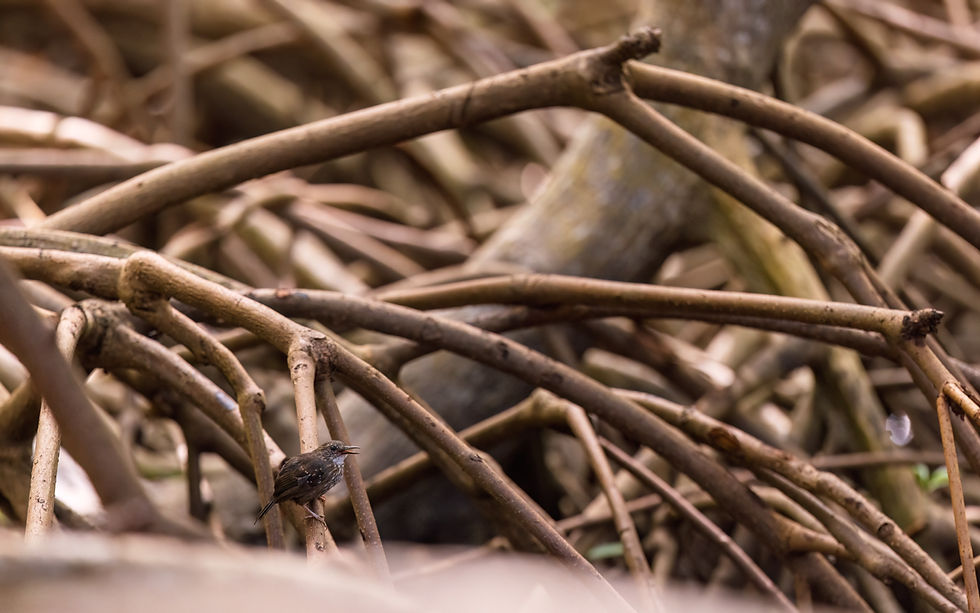
February's black Friday had us on one of the longest days of the trip, after brunch we headed south to Nariva Swamp where our local intel took us to a prime location for the Silvered Antbird we dipped on earlier. While waiting for the antbird, an American Pygmy Kingfisher showed up and tried to steal the show. Tiny and bottle-green, it was preoccupied with whatever was going on in the shallow water below it. To be fair, we also weren't too concerned with the kingfisher, trying our best to locate a brown bird in the brown mass of roots, branches, and water.
While on a futile stakeout for the notoriously unreliable White-tailed Goldenthroat, a drop-dead gorgeous pale morph Long-winged Harrier wafted past, giving us the best view possible of this trip target. Oh, how fortunes can swing in the birding sphere. By this time, the sun was nearing the western horizon, and it was nearly time to head home. Not before a last gasp effort at another target: Rufous Crab Hawk.
This bird showed up in one of the most remarkable of ways, flying in unannounced and remaining unimpressed by us. It was an immature bird, only just getting the namesake rufous on its throat and upper breast. For the 15-20 minutes we stood there, it stared at the now exposed mudflat with a couple hundred fiddler crabs. We, on the other hand, stared at the bird while getting chewed to bits by sandflies.

Gruelling days must always be followed by restful ones, but on a birding trip rest days are travel days. And so we made it across to St. Vincent that afternoon, picking up a few new birds for the trip along the way. Targets on St. Vincent were few; only two very special birds confined to that island. The more significant of which was the Whistling Warbler, a highly threatened species and overall difficult customer. Resident of St. Vincent's rich volcanic forest, to have any chance of seeing this temperamental beast one must be prepared for a hike and at least a thousand mosquitoes.
We had two full days dedicated to finding this bird, and sure enough, we found one on the first day and then glimpsed a second on the following day. Both days were filled with treks in some of the most verdant valleys in the region; that forest remains one of my personal favourite sites to go birding. Not because the birding is prolific (re-read the first sentence of this paragraph if your memory needs refreshing) but for the sheer beauty of the setting. I was constantly enraptured by swooping, moss-covered branches and Purple-throated Caribs attending to vast swathes of heliconias within the jungle dotted with tree-ferns. It must also be said that Whistling Warblers are tiny, dark birds that inhabit this dark forest along with Lesser Antillean Bullfinches – also tiny and dark. To create further confusion, the Bananaquits that kept us company throughout were also entirely black. Any movement necessitated a closer look. From time to time, we were granted views of the second target as pairs of Lesser Antillean Tanagers moved through the vegetation in search of fruit. Birding in St. Vincent contrasted sharply with the days spent in Trinidad for mostly a quantitative reason, it was also decidedly cooler on the smaller island.
Black-faced Grassquit Bananaquit Common Black Hawk St. Vincent Amazon Purple-throated Carib Whistling Warbler
Once our targets were acquired, it was smooth sailing onto the next destination: St. Lucia. Although we could see the iconic Pitons from the northern end of St. Vincent, flight schedules dictated that we fly to Barbados (where we noted the endemic subspecies of Carib Grackle) to then connect with a direct flight to St. Lucia. All was going swimmingly until we remained on the tarmac in Barbados due to no parking spaces available at the airport in St. Lucia. The captain of the plane exiting the cockpit to explain the situation to us in the main cabin was another iteration of pure Caribbean warmth in the face of logistical challenges.
Like St. Vincent, we had two full days scheduled in St. Lucia, again for two main targets that were missed on the previous year's trip: St. Lucia Wren, and St. Lucia Oriole. The wren proved difficult for both trips I did last year, the oriole tended to show up in some unexpected places. Both species have typically been the guilty parties in birding groups not making a clean sweep of the endemics of the island, and so we knew we had our work cut out for us.
Somewhere between the stories of men getting bitten by Fer-de-lance, we managed to catch views of both of our targets on the very first day. St. Lucia Oriole, fairly high in tall trees, but nevertheless distinctive for its elongated profile and black and orange plumage; and a pair of St. Lucia Wrens foraging deep in the dry forests of the north. Birds were aplenty everywhere we stopped, and we thoroughly enjoyed looking at everything – from Grey Tremblers probing broken branches to St. Lucia Black Finches patrolling the undergrowth. The triangular-headed St. Lucia Pewee – a subspecies of Lesser Antillean Pewee – drew coos of adoration when it sat facing us, its rich cinnamon breast contrasting sharply with the faded shades present on other members of the species complex.
Black-whiskered Vireo
Having secured our targets for the island, the second day was very much a free day. What do birders do on a free day? Go birding, obviously. And so we did. This time on the forest trail through the mystical Des Cartiers Rainforest, seeking a view of a Rufous-throated Solitaire. Sadly, it was only my eyes that fell on the lower half of a slate-grey, long-tailed solitaire sitting silently in the understory. By the time I tried to get other eyes on it, the branch was once again bare of bird. Much like the forest in St. Vincent, the setting is phenomenally beautiful, whether there are birds in there or not.
Once we left the rainforest, we were afforded the opportunity to try our luck with another threatened endemic: St. Lucia Thrasher. In discussion with our local guides, it seemed prudent to look for this species in the very early morning, and that we typically do with a fair degree of success. By this time, it was early afternoon, and the first place we checked turned up little more than a Green-throated Carib and a Lesser Antillean Saltator. As we were leaving there, I heard the distant rasping calls of a group of St. Lucia Thrashers, but they were much too far away to warrant any attempt of approach.
We entered the second site with measured expectations. Our guide, walking ahead, suddenly stopped and immediately went into a squat. Turning to us wide-eyed and with a finger to his lips, he signalled that we were to approach with urgency and stealth. Those two have a minuscule intersection, and the three of us tried our best to hurry up without stepping on any of the hundred thousand dry leaves and sticks laying about. At our immediate left was a thicket, and within that thicket were not one but three St. Lucia Thrashers, just sitting there! Just as the guans were doing in Trinidad, these three birds were softly vocalising to each other as they sat on a couple of branches just above the ground. Eventually they each hopped off to begin foraging in the leaf litter, completely unconcerned by our presence. I couldn't believe my eyes – although I had seen them several times before I had never before gotten the chance to photograph the St. Lucia Thrasher, and so I squeezed that trigger.
St. Lucia Oriole, a surprise sighting when we were looking for the St. Lucia Thrasher Lesser Antillean Euphonia Purple-throated Carib St. Lucia Amazon St. Lucia Thrasher
The final piece of the puzzle was waiting for us further north, and by this time we were very tentatively checking the weather. The ultimate Lesser Antillean endemic beckoned: the Barbuda Warbler. Having tied up loose ends in three islands thus far, we returned to Barbados for our connecting flight to Antigua. There was undoubtedly an unspoken air of restlessness surrounding the plan of action for the following days; again we were afforded two full days, these arrangements were slightly more complicated and open to external influence, however.
I wrote another piece on our time spent in Antigua & Barbuda, you can read it here. For now, I will cut directly to the chase. The one reason we were here was the Barbuda Warbler. To see one of these necessitated a visit to nearby Barbuda, 90-odd minutes by ferry. Last year, as mentioned earlier, both attempts to visit Barbuda were thwarted by high winds which made the crossing far too dangerous. This time, we spoke little of past disappointments, instead opting to simply get ourselves at the dock in the pre-dawn with the hope that all will run as it should. And that it did, we touched Barbudian soil (er, sand) just after 8am and were onto the sunshine-yellow and cumulonimbus-grey Barbuda Warbler within a few minutes. I was still trying to dry my socks, but the birds kept coming.
One cannot visit Barbuda and not check out the spellbinding Codrington Lagoon to see the sprawling colony of Magnificent Frigatebirds. I didn't really know what to expect, what I knew previously was that the area was levelled by Cat-5 hurricanes in the recent past. Thankfully, the mangroves quickly regrew, and the birds have since returned. Visiting a seabird colony is very much a sensory experience, and this one was no different. Avoiding the olfactory overload by drifting upwind allowed us to zone into the incredible soundscape that was (for me, at least) entirely unexpected. I knew frigatebirds to be silent creatures, riding unseen currents high in the sky, silhouettes at best. Even when they are harrying tropicbirds off of Little Tobago they make very little headway in the vocal department; and so I became entirely absorbed in the array of clicks and other percussive noises which permeated the colony. I noticed that males in particular would hover over females and young birds on their massive wings, deftly leaning forward as they emitted a series of clicks that recalled cetacean vocalisations more than anything I've heard from a bird.
Antillean Crested Hummingbird Barbuda Warbler Barbuda Warbler Caribbean Elaenia Bananaquit A potentially leucistic Magnificent Frigatebird Magnificent Frigatebirds at the roost Interaction between adult male (above) and immature. Magnificent Frigatebird, in peak display Magnificent Frigatebird chick
It was at this point in the tour where I finally took my phone out to record a short video of the frigatebirds; the first time in almost two weeks that I used my phone to create any sort of content. True to my stubborn ways, I only shared that video on my social media today, just over three weeks after the fact. The purpose of taking the video was more for my own gratification than for the usual "here's what I saw" and "this is where I've been" currencies, I simply couldn't get over the sounds of that colony. Ever so often, I would still replay that video and be taken right back to the colony amidst hundreds of birds that have captivated my imagination since childhood.
Our (much more tumultuous) return voyage to Antigua brought us to the end of the tour, but just as we had some pre-tour birding, we also enjoyed some post-tour birding. Antigua is home to a resident population of waterfowl that isn't found in many of the other islands further south, so we enjoyed an afternoon patrolling some inland waterways for Pied-billed Grebes, West Indian Whistling-Ducks, American Coots, Ruddy Ducks, and many others.
Black-whiskered Vireo Mangrove Yellow Warbler Common Ground Dove Sora West Indian Whistling-Duck Grey Kingbird American Coot Zenaida Dove White-winged Dove White-crowned Pigeon
Over the course of those two weeks, the freedom from the tasks associated with maintaining a social media presence liberated me from the prison of the present-day creative landscape. I found myself musing over concepts instead of scrolling, and while I missed the interaction with many people on the platform, overall I felt much better. For now, I have resumed my role as I settle back down to administrative duties, but significantly refreshed and with much more clarity.


Comments