Quick-fire Birding Bonanza in Guyana

Life is a careful balance between a whim and a plan, and somewhere along that spectrum we decided to hop across to neighbouring Guyana for a week last December. I’ve been working on a still unpublicised project, the details of which shall be revealed in due course. For this project, I have a few photographic targets, some of which are much easier to encounter in Guyana than in my home island. Admittedly, a wave of laziness was involved, but also I felt distinctly more comfortable roaming around with my good friend Leon in his landlocked patch of jungle and savanna than I did in Trinidad - given the species I intended to photograph, of course. Furthermore, it's always better to bird with friends.
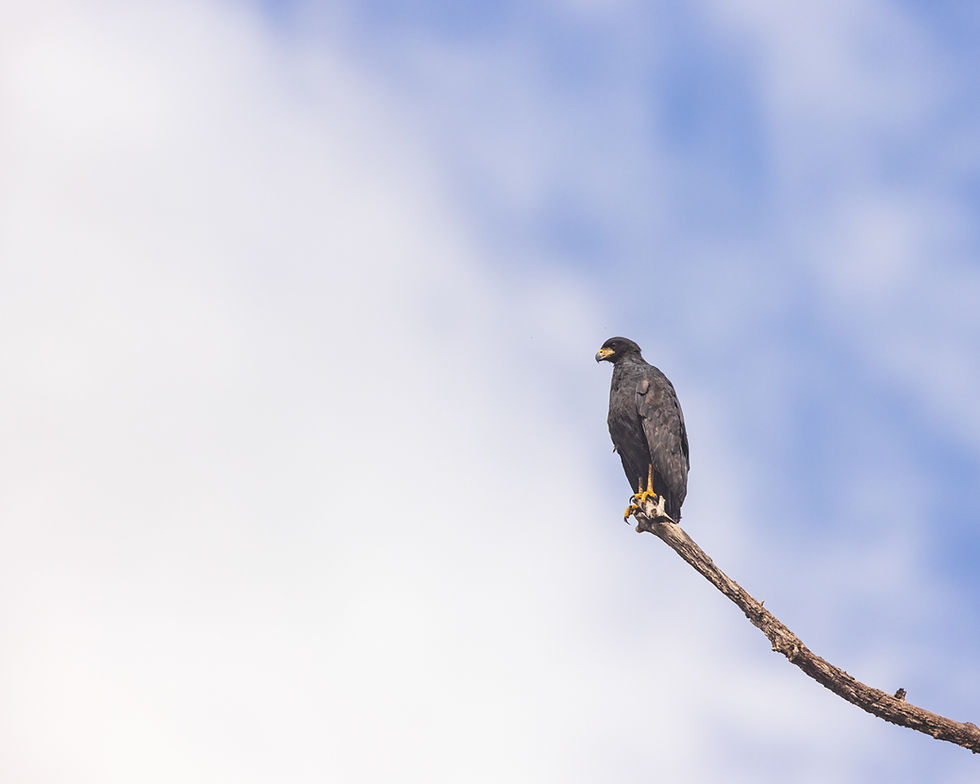
Georgetown changed quite a bit in the two short years since we were there last. Leon instructed me to ensure my camera was ready from the moment we left the airport, and I happily obliged. Our first stop was Bounty Farm, en route to our hotel for the night. We linked up with Jono de Groot who took us on a short stroll through the forested grounds. Waterways crisscrossed the property, and the presence of large trees at the water’s edge made a resident pair of Slender-billed Kites feel comfortable enough to have a family on the property. A pair of Black-collared Hawks – much larger and more colourful than the monochromatic kites – kept an eye on proceedings from higher in the trees. Both species are on the record for being seen in T&T, but they are incredibly rare. I remember an unsuccessful mission in the search for a reported Black-collared Hawk in southwest Trinidad probably in 2012 or even before; the converse happened with Slender-billed Kite in 2024. When leading a tour in southwest Tobago, we noticed a bird soaring in the distance. Black Vulture was my first guess, they are rare on the island but not unreported. This bird lacked the silvery wingtips, nor did it have any white markings on its tail which would have suggested the other suspect: Great Black Hawk. It was Tobago’s first and (at least until now) only record of Slender-billed Kite. At Bounty Farm, they were much closer, and much more confiding.

The avifauna of coastal Guyana features a selection of species that feels like an expanded version of those found on Trinidad. I suspect northern Venezuela would feel very much the same way, given the shared geological history of this part of the world. In addition to the greater diversity, many of the frequently seen mainland species are rare on the island. For example, common species like Greater Ani and Sulphury Flycatcher are severely range-restricted on Trinidad. I took the opportunity to make a few images of a hunting Greater Ani as well as blindly fire into a flock of feeding Fork-tailed Palm Swifts while Leon raided a tangerine tree on our way out. Despite there being little faith in my method with the twisting and twirling palm swifts, I had a few tricks up my sleeve.


The transition from stinging sun to disappearing light happens rapidly in these parts, and I’m sure the Laughing Falcon had a chuckle from its lofty perch on a roadside pole as we inched forward in the evening rush hour traffic heading to our hotel. After dropping our bags off, we found a relatively new restaurant around the corner – where we had a proper celebratory feast. Who says we must wait until the final night to have this type of celebration? It was only when we were near to polishing off our plates we learned that our wake-up call the following morning was coming at 3:30am. This was supposedly to make up for the fact that there was no time zone difference. How else were we to feel as though we'd gone somewhere?
The first hints of dawn the following morning found us tearing through the white sand forest. Golden light filtered through the stunted trees that gradually tightened their grip on the sandy road. At times, we would have to slow down to ensure that no branches would be infiltrating the vehicle. Leon made some delicious arepas for us which kept us satiated for the better part of the morning as we poked around in the R’s Farm – one of Guyana’s best known spots for hummingbirds. Glittering-throated Emeralds were aplenty, along with Blue-chinned Sapphire and Ruby-topaz Hummingbirds. There were one or two Blue-tailed Emeralds as well, I only realised belatedly as they looked just like the sapphires but made a different vocalisation as they disappeared. I was thrilled to finally get my camera on a Common Tody-Flycatcher at nearly point blank range, as I had missed out on this species on my previous visit.

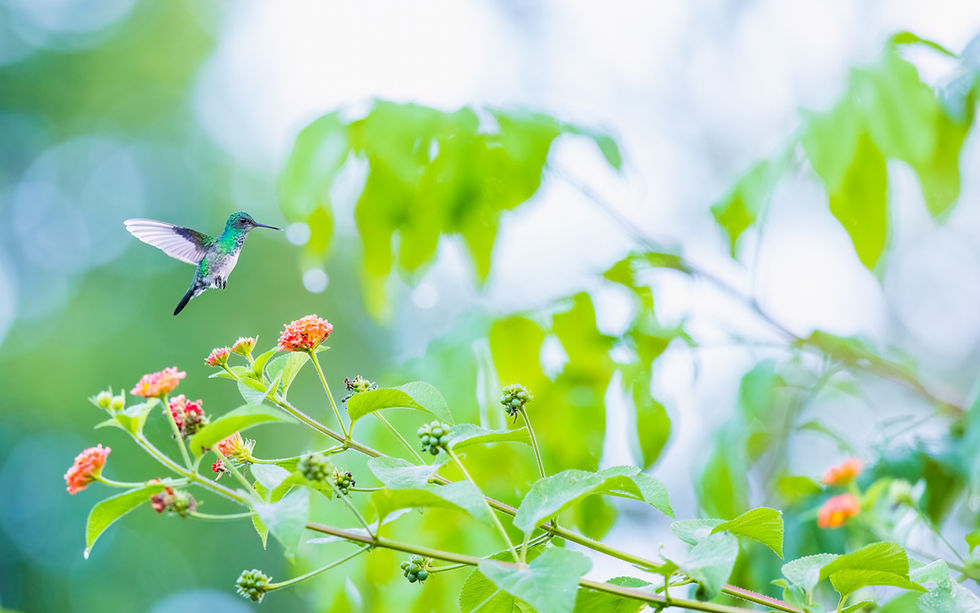

As we ventured further into the property, we came upon a fruiting tree that was entertaining a few White-crowned Manakins. They were all females which rendered them particularly difficult to see unless they moved from one branch to another. Fortunately, they were quite active as feeding manakins tend to be – hovering briefly at a bunch of berries before picking their preferred fruit to then sit on another branch and consume it. A pair of very distinguished looking males would eventually show up later that morning, their jet black plumage contrasting sharply with a snow-white cap. Deep red eyes were much easier to discern on the grey-headed females, though.


Flowers and fruit were the fuel behind a revolving door of characters, including small groups of Blue Dacnis and Brown-throated Parakeet. A female Amethyst Woodstar would periodically show herself, only to be swiftly chased off by the larger hummingbirds. Intermittent showers punctuated the morning, Short-crested Flycatchers sat silently in the overhanging vegetation and White-throated Toucans tossed boomerangs of sound waves across the valley. A recently renamed Common Squirrel-Cuckoo basked in the morning sunshine, delicately fluffed up. I walked directly past it in an effort to get a slightly better angle, which surprisingly did not bother it in the slightest. Only when a beetle circled within striking range did it draw itself back into the sleek, elongated dinosaur we know it to be - stretching forward to pluck the insect from the air without its tiny zygodactyl feet ever loosening their grip on its perch.

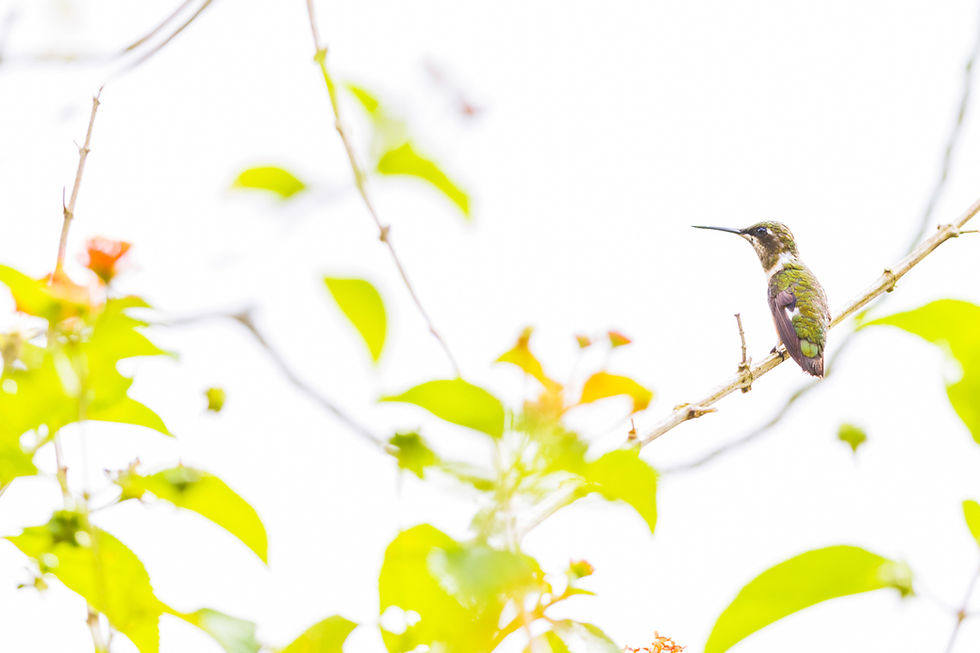


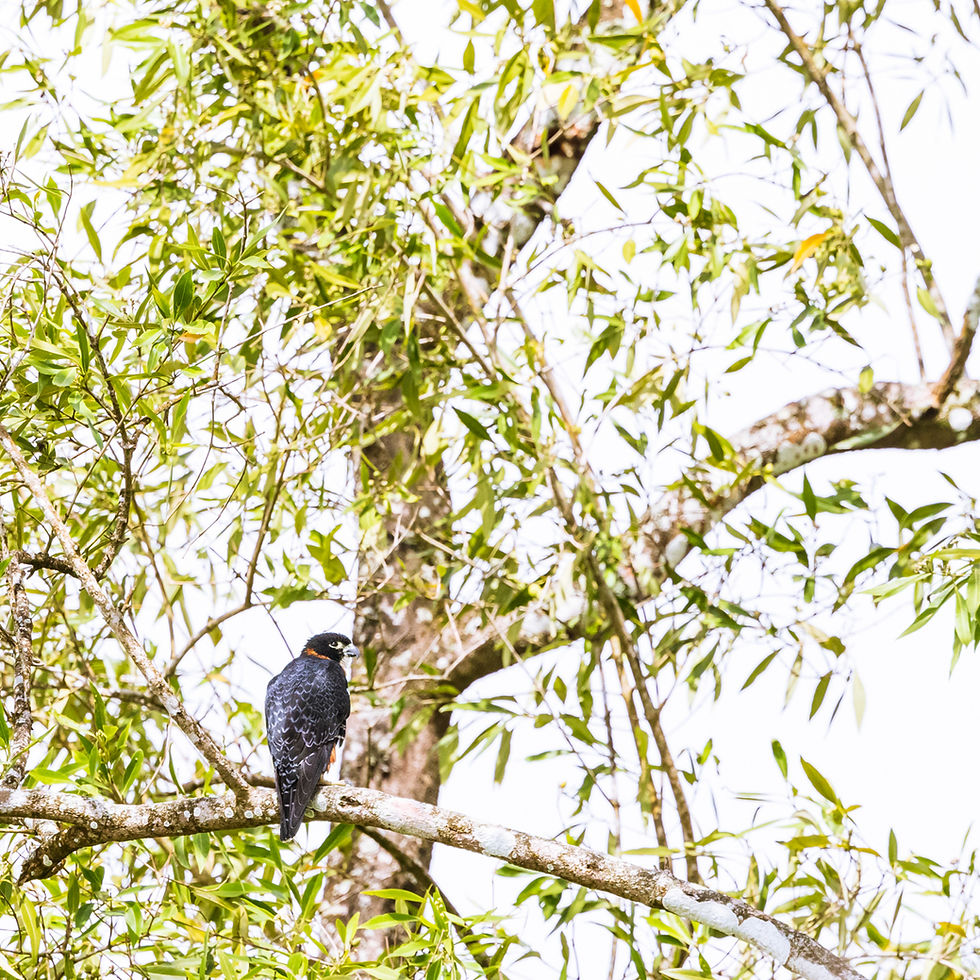
Our next stop was at the Botanical Gardens in Georgetown, but before getting there we stopped along one of the country’s busy highways to catch a view of a distant rarity: an adult Orange-breasted Falcon! I had previously thought of this bird as a high-altitude specialist, and surely many others have shared this sentiment - but one was found by Jono de Groot in this patch of sparse trees and open habitat some weeks prior to our visit. It was a life bird for me despite sporadic reports of one in Trinidad’s Northern Range within the last couple years.
My main target in the Botanical Gardens was the ever-present Snail Kite. I wished all assignments could be this straightforward. Within a few seconds, we found an adult male that hopped off its lotus perch to grab a snail from the shallow water. We were then gifted a lovely flyby before it perched in a nearby tree to extract the snail’s soft bits.

As shadows lengthened, our conversations began to drift into the plans for the following day. Another early morning start was planned, but this time we would be driving south for several hours into Guyana’s emerald heart, where truly anything is possible.
That journey began in the dark, within a couple hours we were at the town of Linden while shadows were still long. Before getting onto the Linden-Lethem Highway - not necessarily what you think - we secured a few egg balls. I love egg balls. They are delicious and nutrient-dense, and done properly are one of the finest field munches around.
A significant portion of the Linden-Lethem Highway has been paved since our last visit. Tarmac cutting through otherwise pristine jungle feels a bit unsettling, to be honest. I understand that for commuters it makes the world of difference, easily shaving four hours off what is often a dawn-to-dusk operation – but my heart is with the wild. On our way into Guyana’s interior, we saw several smudges on the road that were once animals. Few were identifiable; one of the fresher corpses was once a Southern Tamandua. Roadkill that is not removed attracts scavengers, and just like poison making its way up the food chain, so does the risk of being run over. Vultures and opportunistic carnivores can easily fall victim to this, especially animals that operate heavily on sound. It may seem a bit counterintuitive that in the primordial silence within this great forest that something cannot hear an approaching vehicle – but it is quite a unique phenomenon. Without the constant drone of anthropogenic noise, even a small car carries with it an unimaginable roar that can be heard from kilometres away. Several times I moved out of the road after hearing an approaching vehicle, only to look around and find nothing there. After a few minutes, a paltry sedan would rocket past on the fresh tarmac, sounding much more like a supersonic jet than a corolla. I could easily imagine how confusing this can be to the unfamiliar.
Before we departed the paved section, we came upon a few vultures feeding on some discarded offal on the side of the road. They were mostly Turkey Vultures and a single, gargantuan, white bird: a King Vulture! I had come close to this bird on our last visit but didn’t see it as it had soared behind a hillside before I got eyes on it; I also had a half-decent look at one in Costa Rica a couple years ago. But this was phenomenal. Leon inched the vehicle closer, and the vultures eventually regained their complacence and returned to the ground for a short while before deciding to ascend to the best perch in the house. A Turkey Vulture held that perch for a brief moment before the King Vulture ousted the much smaller bird. I have been captivated by King Vultures since childhood, and it was such a life-altering experience to observe one at leisure.

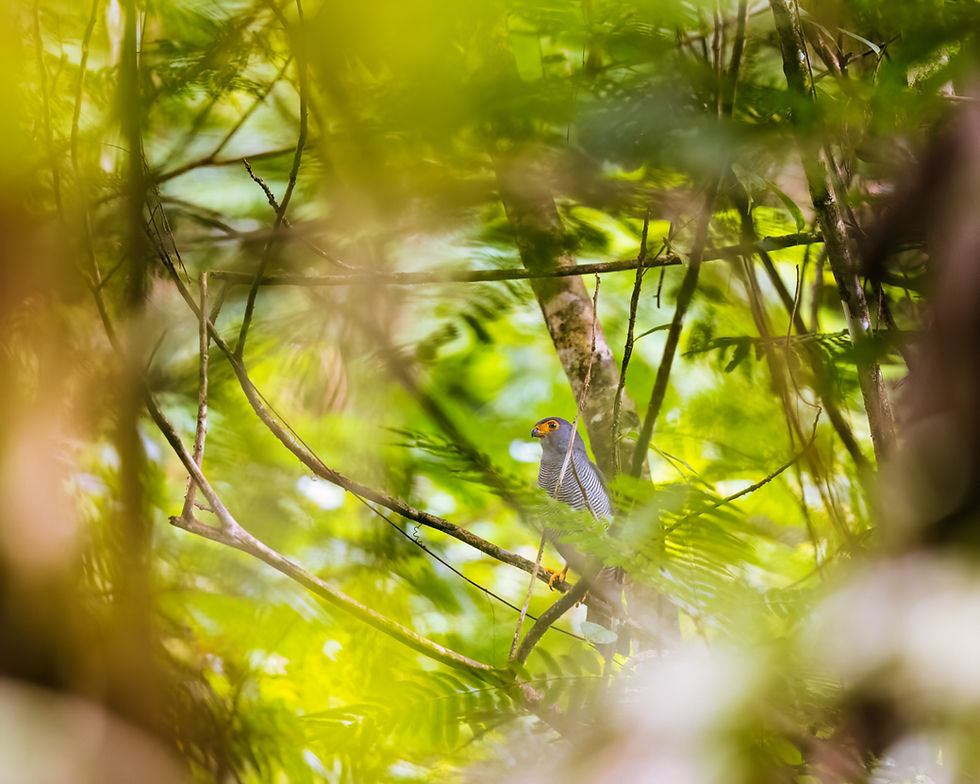
We continued our southbound journey at pace, the tops of trees peppered with small birds that would occasionally take short, graceful, looping flights on triangular wings; white rumps on otherwise dark birds cemented them as Swallow-winged Puffbirds – anomalies within their family of mostly plump, stoic creatures within the forest, not above it. Our next stop was a few hours later, on the red mud road I was familiar with. Here, we stopped for stretching and snacks but it was likely not even a full minute before Leon found a Double-toothed Kite that was sitting silently on a diagonal branch. After ascertaining the bird’s comfort level, I adjusted my angle for a better photograph. Happy with what I got, I was ready to move on, but the bird suddenly dropped off its perch, landing on an even better branch. When I got my eyes on it, I noticed that it had grabbed not one, but two grasshoppers, and had begun immediately chomping one of them.
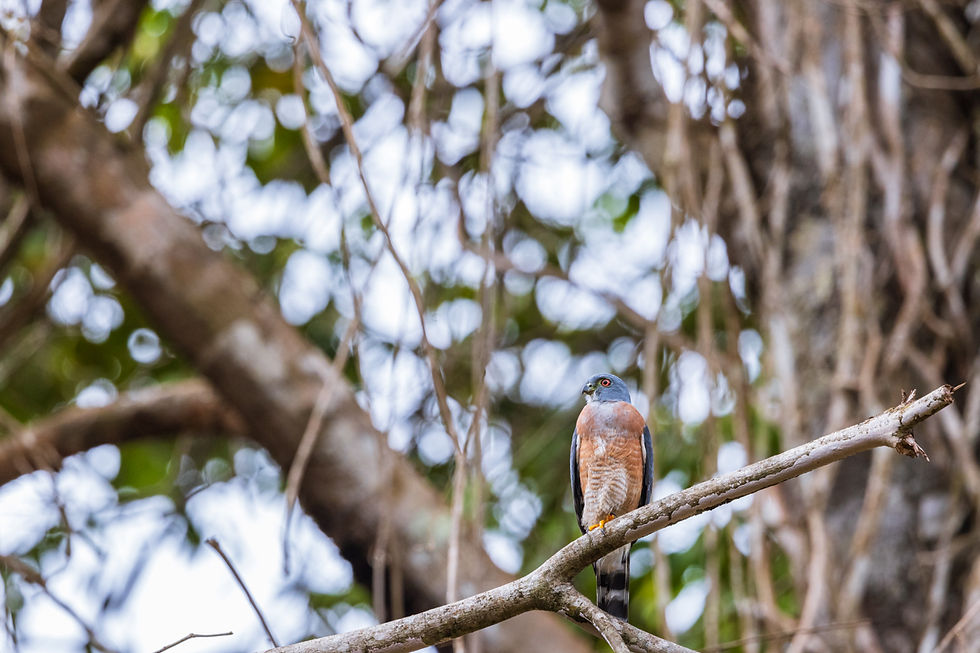

I wondered if this bird deliberately targeted pairs of grasshoppers or if it was a genuine streak of luck for it. After having a good look I realised that it was a mating pair of grasshoppers, tragically caught in the act. The bird could only hold one at a time, and the female managed to escape, leaving her mate to serve as brunch for this exceptionally beautiful raptor. Question answered, the bird was only after what it could eat. There was no sense in killing two grasshoppers when only one could be consumed at a time. Maybe a lesson for us hoarders somewhere here? Either way, we thoroughly enjoyed all this unfolding as a gentle shower of rain drifted in, casting another dimension to the already magical atmosphere. I could only ponder thoughts surrounding natural selection from the perspective of the grasshopper. Maybe nature’s way of ensuring that the less vigilant do not pass on their genes and practices.
Our first stop was still nowhere near, although significantly nearer than before. Journeying through Guyana cannot be done without patience and prudence. Eventually, we arrived at the Kurupukari Crossing – where we purchased our barge tickets and waited some more. Except that there is always something to see, from a pair of head-tossing White-throated Toucans croaking to one another to a Black Caracara balancing on the wispy upper branches of a bare tree, to the flash of a Green-tailed Goldenthroat feeding on flowers as the rain returned.

The crossing is always an interesting thing for us, as tourists, of course. To the locals, it was clearly as mundane as walking to the shop. One must reverse onto the barge in order to drive off easily. Although hurriedly may be a more apt description, given the gesticulations of others. Interesting given that everyone just spent 30-45 minutes quietly waiting to cross. As the barge motored across the ancient Essequibo River, its rapids roared on either side, tumultuous white water cascading over giant boulders – a torrent encased by thick forest on either side. It is at this point where one notices the sky take on a dimension of vastness. Here is true wilderness, and the sky serves terrestrial life as it should, without the trappings of noise and light pollution.
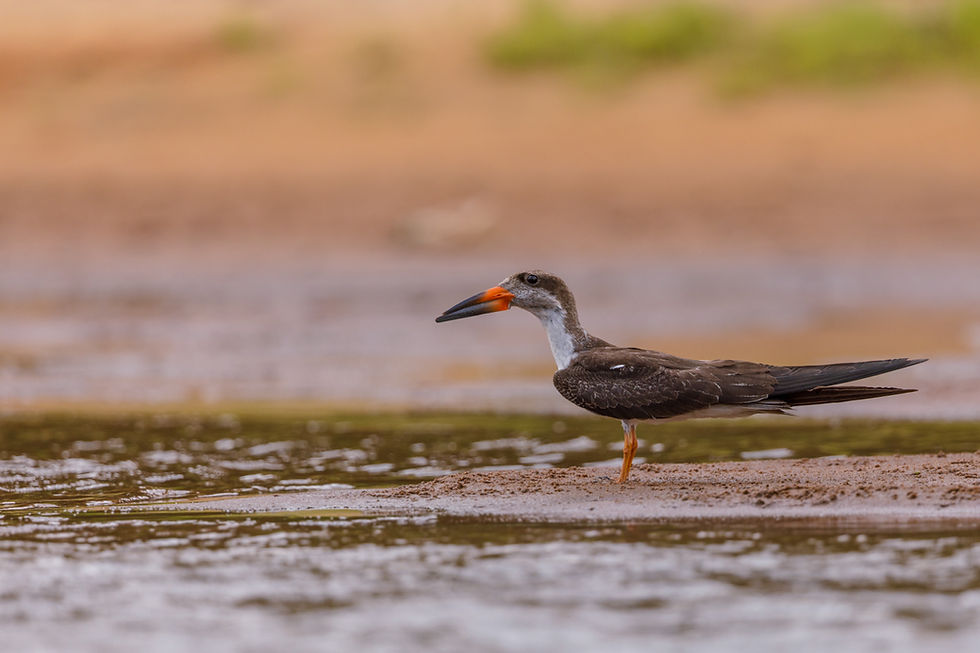
Just around the corner on the opposite side of the Essequibo is Iwokrama River Lodge. From the lodge grounds, one has direct access to the river. Its banks were replete with Pied Plovers, a striking shorebird native to South America. Over the water, White-winged Swallows swooped low to grab insects near the surface. Massive trees towered over the clearing, within which at least a few hundred bird species chirped, chucked, and hooted.
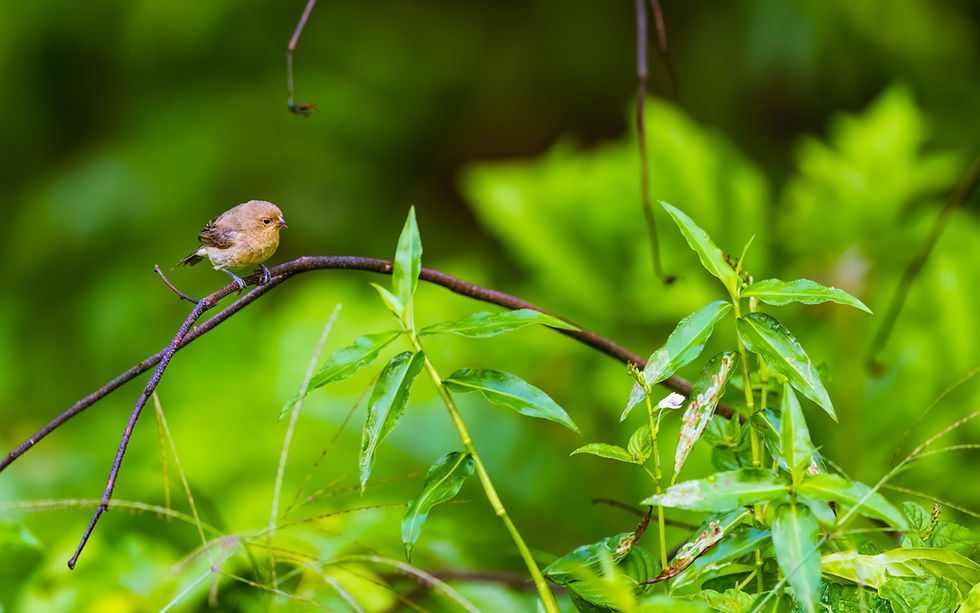
Checking in sometimes feels like a case of FOMO, something is always happening when one is filling out the check-in documentation at the reception desk. As we got out and strolled around the lodge, Blue-and-yellow along with Red-and-green Macaws made a huge commotion as macaws do when they are doing anything, really. Huge and spectacularly plumaged, free-flying macaws always demand attention – in this case they seemed to raise the ire of a pair of Bat Falcons, one of whom dive-bombed a pair of Red-and-green Macaws as they drifted too close to the falcon’s preferred perch. Grey-breasted Martins observed from a safe distance above, while diminutive Chestnut-bellied Seedeaters wisely stayed close to the ground.


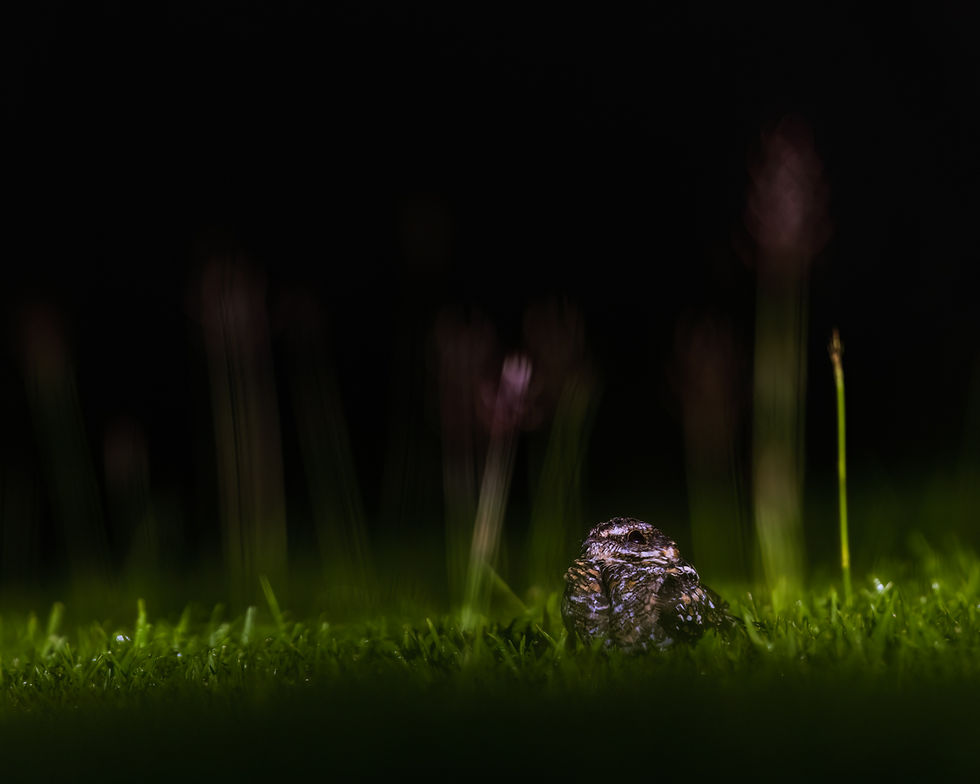
At night, Ladder-tailed Nightjars dotted the grounds, often under lights. One enjoys deep and restful sleep in these parts, darkness and silence cradle the dream state like nothing else can. The peace is only shattered by the alarm clock that jolts the body awake when it is time to go birding. But after all, that is what we were here for.
Dawn caught us on the trail, where screeching caracaras and the unreal-sounding Capuchinbird were already belting out their distinctive vocalisations. A Great Tinamou scuttled out of view on the trail ahead of us, I didn’t even get a whiff. Along the trail, numerous species of fungi were to be found on nearly every piece of fallen vegetation, with some small mushrooms growing from woody, moss-laden vines. Woodcreepers accompanied antshrikes and various antwrens in mixed species flocks in the mid-storey. Whether or not I see a single bird on this trail, it is entirely humbling to walk with these giant trees, their buttresses sprawled like prehensile toes gripping the earth. In the din of the early morning, trunks are still wet, leaves heavy with dew. Monkeys jumping from branch to branch cause mini showers for those below. Birds that walk through the undergrowth emerge wet and bedraggled. The air remains heavy with humidity, one gets sweaty easily despite the trail being mostly flat.


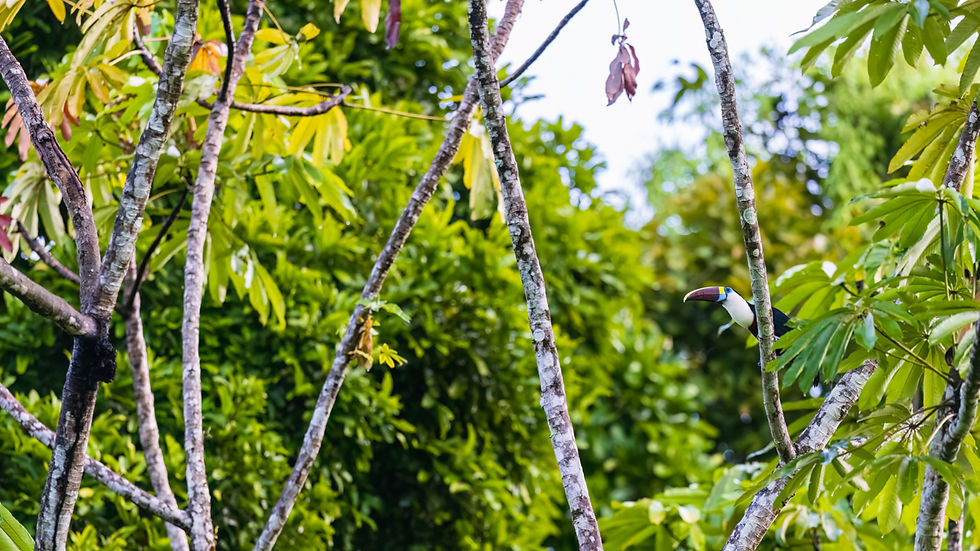


Throughout this day, as families gathered for seasonal festivities and children opened gifts, we continued scouring the trails for all manners of birds. Familiar faces like Crimson-crested Woodpecker and Channel-billed Toucan were accompanied by new sights in the form of Yellow-tufted Woodpecker – a very striking character I vowed to encounter again. My antpitta count was also growing, albeit wholly in the category of “heard only”: Scaled (from Trinidad), and now, from Guyana, Spotted and Thrush-like Antpitta.




At breakfast the following morning, a curious blob on an emergent branch caught our eye. At least a kilometre away, a view through Leon’s spotting scope only made it more suspicious. After photographing it and zooming into the image on the back of my camera, we were sufficiently convinced that it was a young Ornate Hawk-Eagle attempting to dry itself in the wind above the canopy. The surrounding jungle consistently revealed different sights and sounds, rewarding those who dedicated the most time and, on occasion, those who were simply too lucky for words.


Our journey continued that afternoon along the red dirt road through the remaining jungle before the vegetation suddenly shifted into gallery forest – a brief transition zone before we burst out into the expansive Rupununi Savannah. After spending a few days staring up into thirty-metre trees, the sudden sense of space hits the observer unexpectedly. Dusk was in full swing by the time we emerged from the last strands of gallery forest, the open savannah properly lit by the afterglow. In the distance, the Pakaraima mountains rose from the savannah, making it feel almost like another channel, though a significantly wider one.

In all this splendour, Leon suddenly slammed on the brakes, our vehicle careening to a halt in a cloud of swirling dust. He immediately threw it in reverse, with a single word: anteater. How he managed to see this bush-coloured animal in the bush in near darkness was beyond me, but I was already long past marvelling at his abilities and ceased questioning anything.
Confusingly, as I was attempting to photograph my first Giant Anteater, I was suddenly surrounded by a selection of nighthawks: from the tiny Least to the slightly larger Lesser, and even a single Nacunda Nighthawk, the largest member of the family. Despite being much more adept at photographing birds, I tried my best to ignore the nighthawks and concentrate on the anteater. Which ultimately proved to be far more difficult than I had anticipated. In wildlife photography, the eyes are always the key, and Giant Anteaters don’t really pay much attention to their eyes – tiny, beady, and set in an awkward position. What made it worse in my situation was that the animal was almost always facing away from me.

I may have come out with far more “keeper” images had I been photographing the nighthawks, but at least I managed one barely usable frame of the largest anteater in the world. If elephants are boulders, the Giant Anteater is a shaggy box with a vacuum at one end and a feather duster at the other.

Dawn on the Rupununi is a protracted affair. Typically, we must leave our quarters while it is still properly nighttime – the awareness of this schedule tends to curtail conversations at the dinner table, irrespective of how utterly interesting they can be. We spent a night at Rock View Lodge, a charming homestay managed by Colin Edwards and his family. Colin is warm, witty, and runs amok with story after story: after all, he was the man responsible for the Linden-Lethem Highway in the first instance. For clarification, we’re talking about brokering the initial agreements between Guyanese and Brazilian officials to build the road through impenetrable jungle to link the two towns. The paved version could likely cost travellers around five to six hours, Colin’s journey took three weeks. The beast of burden that inched and winched its way southward through nearly five hundred kilometres of forest still was parked on the lodge grounds, though I’m not sure if it would start. That night, we pored over Colin’s old photo albums as he filled our ears with innumerable tales and even more jokes before heading into bed.
Undoubtedly we passed numerous fields filled with all manner of avian life on our drive the following morning – only that it was still dark. Leon had a plan, as he always does, and shortly after daybreak we came to a halt next to a field with Pinnated Bitterns, Jabiru, Maguari Storks, Great Egrets, and an Azure Gallinule. White-tailed Hawks topped fenceposts, and Crested Caracaras and Savannah Hawks prowled the fields as Yellow-chinned Spinetails rattled from thickets – a true Rupununi sunrise.


One cannot visit the Rupununi and not get on the eponymous river. Whether morning or afternoon, a cruise on this meandering course is mandatory. On our previous visit, we had our sundowners moored to overhanging vegetation on a bend in the river as a family of Giant River Otters quietly witnessed the end of the day from the opposite bank. This time, we struck out in the morning, albeit at a decent time: after breakfast.
An aspect of the natural world that has spoken to me on multiple levels is its scalability. Whether up or down, the plot persists while the characters change costumes. The vastness of the Rupununi is evident throughout – no question why Guyana is dubbed the land of giants. On the banks of this mighty river, hulking Jabiru build sprawling nests in massive trees. These behemoths are superlative beasts; they are the tallest flying birds in the western hemisphere and have a wingspan that can approach almost three metres. Truly, a scaled-up version of your standard bird that builds its nest on a branch!




Back in the savannah, many of the fields were burnt in the weeks prior to our visit. It was easy to see Crested Bobwhites in the denuded fields, and even easier if any of them ventured onto the dusty roadway. They were much less straightforward wherever there was still vegetation.


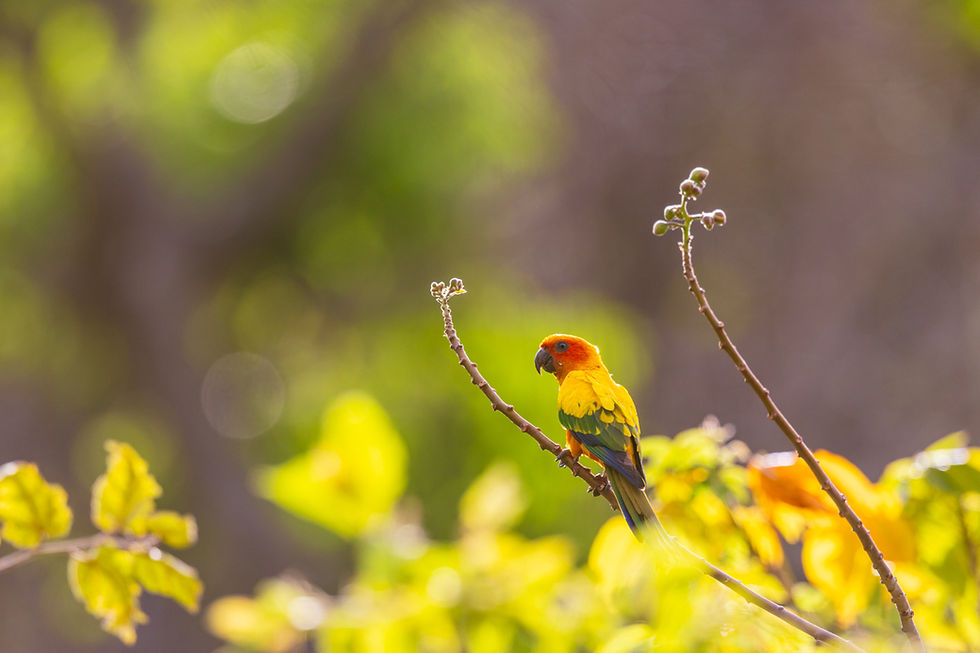
When roaming in the Rupununi, the metaphorical monkey on my back never let go. That monkey was in the form of a single bird that led us on a wild goose chase on our last visit: Sun Parakeet. We really need to revisit that adage as there are clearly many birds that are much more difficult to find than a goose, by the way. On that prior occasion, after searching all day without hearing as much as a single squawk, we conceded defeat. The famous bird of Karasabai had eluded us; the sun had punished us. That was the first time Leon had ever dipped on finding Sun Parakeets in all his years guiding in Guyana. This time, we were hoping to land on a more favourable side of fortune.
I couldn’t believe it when we heard their distinctive calls after no more than ten minutes. We spent upwards of an hour with these feathered flames as the sun swiftly climbed toward its zenith. As the temperature rose, I spoke fondly of our previous adventure looking for these endangered parakeets. Thankfully, I was able to comfortably retreat to the shade on this occasion.


With that final victory, we commenced our return journey to Georgetown. Air conditioning on, sunglasses on, cameras packed. Even though it was still morning when we left Karasabai, we ultimately coasted into Georgetown long after sundown.



Guyana truly enriches the soul; few places rival the raw richness and natural bounty of this tiny country – a feat attainable by all, undoubtedly, if only we resist the urge to plunder. It is my hope that Guyana makes judicious decisions in the coming years, as the promise of plenty is presently bubbling on the horizon.


Looks like an epic trip!! Thanks for pics & deets! 👍🏽🪶👍🏽